This article originally appeared as a designer diary from the Kickstarter for my latest board game design: Earthborne Trailblazer.
In these first couple days, I’ve gotten questions from folks asking about what makes this game different from Earthborne Rangers, as well what is going to keep it feeling fresh for many playthroughs if the design doesn’t use scenarios. To address these questions, and give you a closer look at the game, I’ll be doing a deep dive on some of the inner workings of the game for you.
NOTE: This article has some minor spoilers of content from the vertical slice demo shown in Team Covenant’s Gameplay Preview.
The Dynamics of Trailblazer
If you’ve taken the opportunity to read the Gameplay Overview section of our project page or watch our Learn to Play video, you should have a decent understanding of the basic mechanics of the game as well as a good picture of the moment-to-moment gameplay. As you might imagine, however, that isn’t the full picture. Our goal was to make the mechanics elegant and approachable, allowing for the magic of the design to emerge from its dynamics.
“Dynamics” is a term from a theoretical framework for game design called “MDA Framework” from this paper by a trio of game designers and researchers: Robin Hunicke, Marc LeBlanc, and Robert Zubek. In brief, it divides the game experience into three categories:
Mechanics are the basic building blocks of a game. The smallest elemental pieces of the game system. Effectively, these are the rules.
Dynamics are the patterns and experiences that emerge from these mechanics interacting. These are the heart of the game. They are the interactions that create the players’ experiences — feeling tension, excitement, friendship, etc.
Aesthetics are the actual experience of the game itself. The art, stories, emotions, and narrative framing that wrap the other elements of the game.
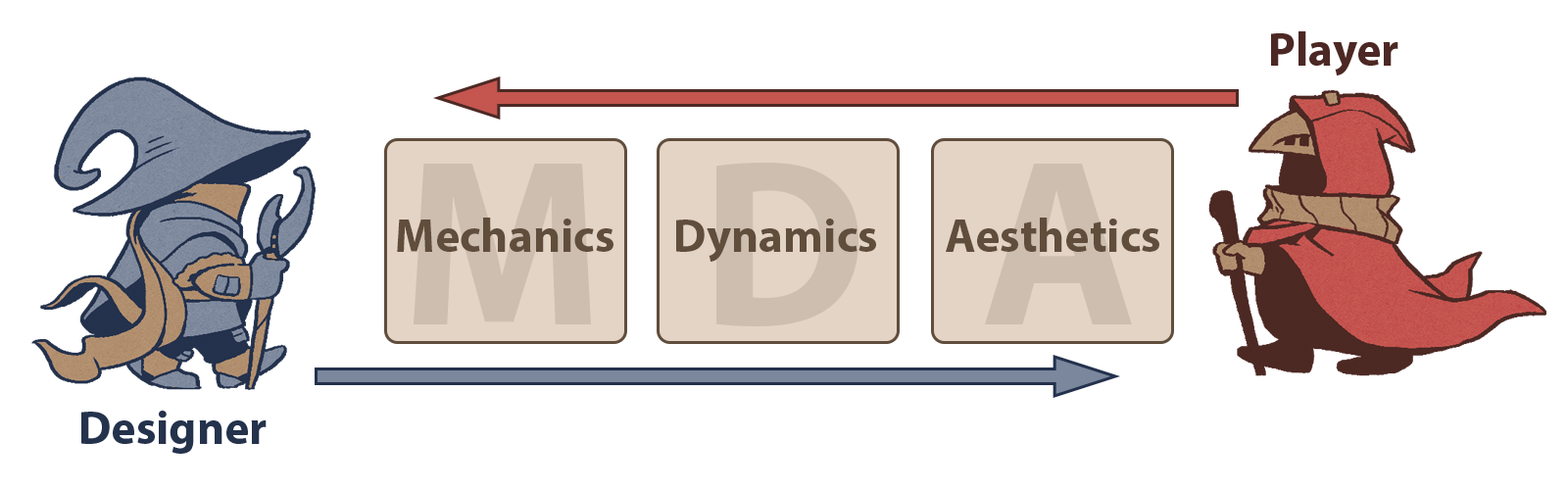
The designer and the player first experience MDA framework from opposite perspectives.
While describing the basic mechanics is relatively easy to do, describing the dynamics of the game — the patterns and experiences that emerge through play — is a bit more challenging, but I will do my best!
For those of you who have played Earthborne Rangers, I think you’ll agree that a lot of the most magical moments come out of the dynamics of the game — when the ecology interacts in an unexpected way to create a unique puzzle for you or tell a singular story, that’s the true magic of the game. The scope in Earthborne Trailblazer is very different, but even though you’re going to be dealing with bigger problems and bigger timeframes, the dynamics of how these pieces interact make the game bigger than the sum of its parts.
So, let’s take a quick look at how stories emerge from play, how they can alter the game, and how they can interact with one another to create unique play experiences each time you open the box.
The Plot Thickens
Trailblazer is first and foremost an open-world game, but unlike a lot of other open-world tabletop games, it is set on a fixed game board. It’s still very important to us that the world feels massive, with lots of small corners to discover and get lost in. So, instead of creating a wide world with only surface-level detail, we're striving to create a world that may be small geographically, but one that is at the same time deep, and rich with detail.
The first step toward earning Ranger badges and winning the game is to find leads on people in need of assistance or resources to secure for the Rangers. These can potentially be anywhere on the board, tucked into every corner of the world. As just a few examples, stories can be kicked off by:
Finding a companion out in the world.
Finding a rare or specific item.
The event deck introducing new opportunities or threats.
Completing a rare or difficult option during an encounter.
Bringing together elements of the world at the right place and right time (hinted at by different pieces of story).
Finding hidden corners of the world.
Getting an “unlucky” confluence of crises and world events.
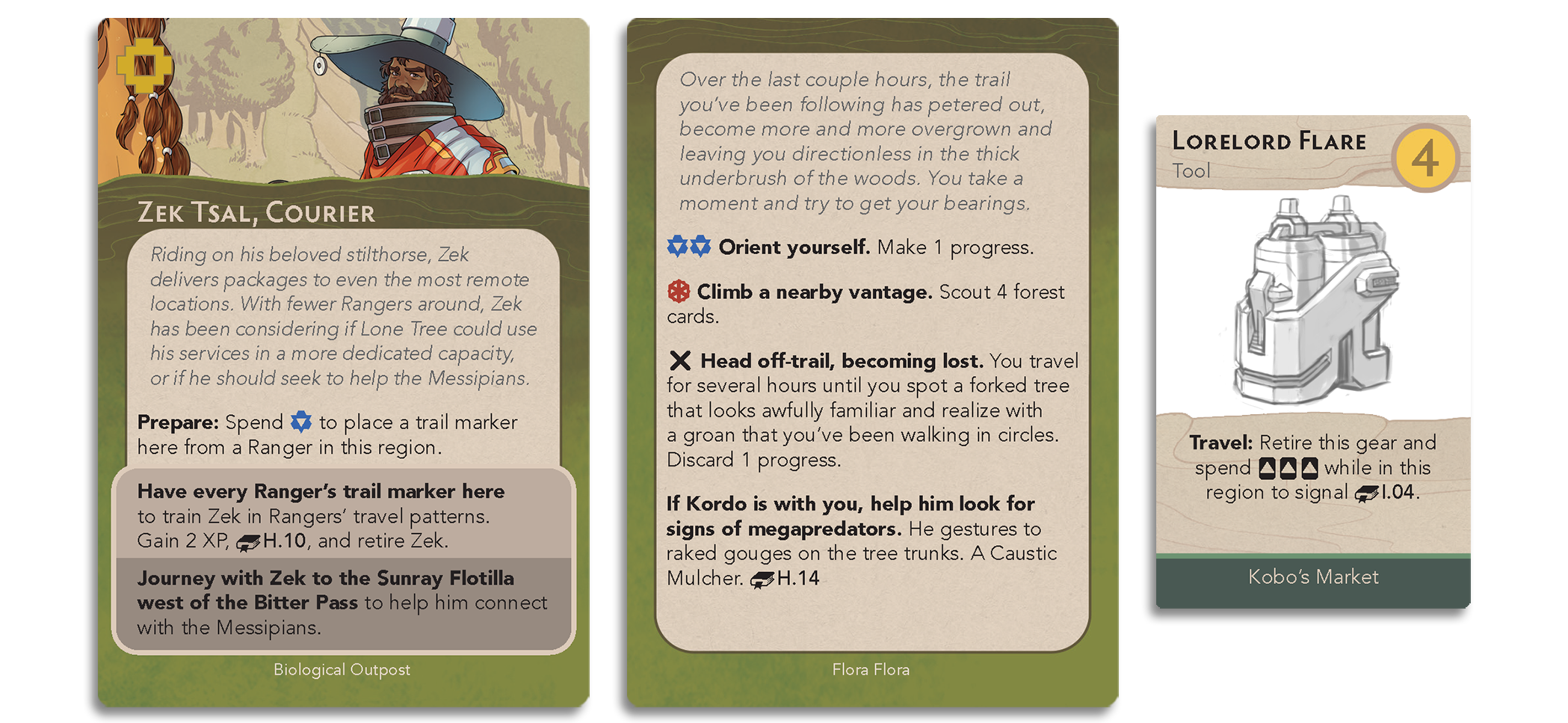
Different cards that kick off stories (art is placeholder).
There are so many story hooks to find and uncover, and such a limited amount of time and resources between the players, it will be impossible for you to even find (let alone pursue) all of these in a single session. Beyond that, most of these stories have branching outcomes based on your choices, randomized events, or your previous successes or failures. We’re confident that after a dozen sessions you will still be uncovering details you haven’t seen before (or even more if you include the Visitors from Afar expansion).
Undertaking Endeavors
When a story begins it will add cards from the card library to the game, introducing new opportunities around the board in the form of cards added to the terrain deck, and new events to the event deck that will unfold on later rounds. If you pull on a story thread long enough it can become something that alters the rules of the game and requires the attention of all of the Rangers by adding an endeavor to the board.
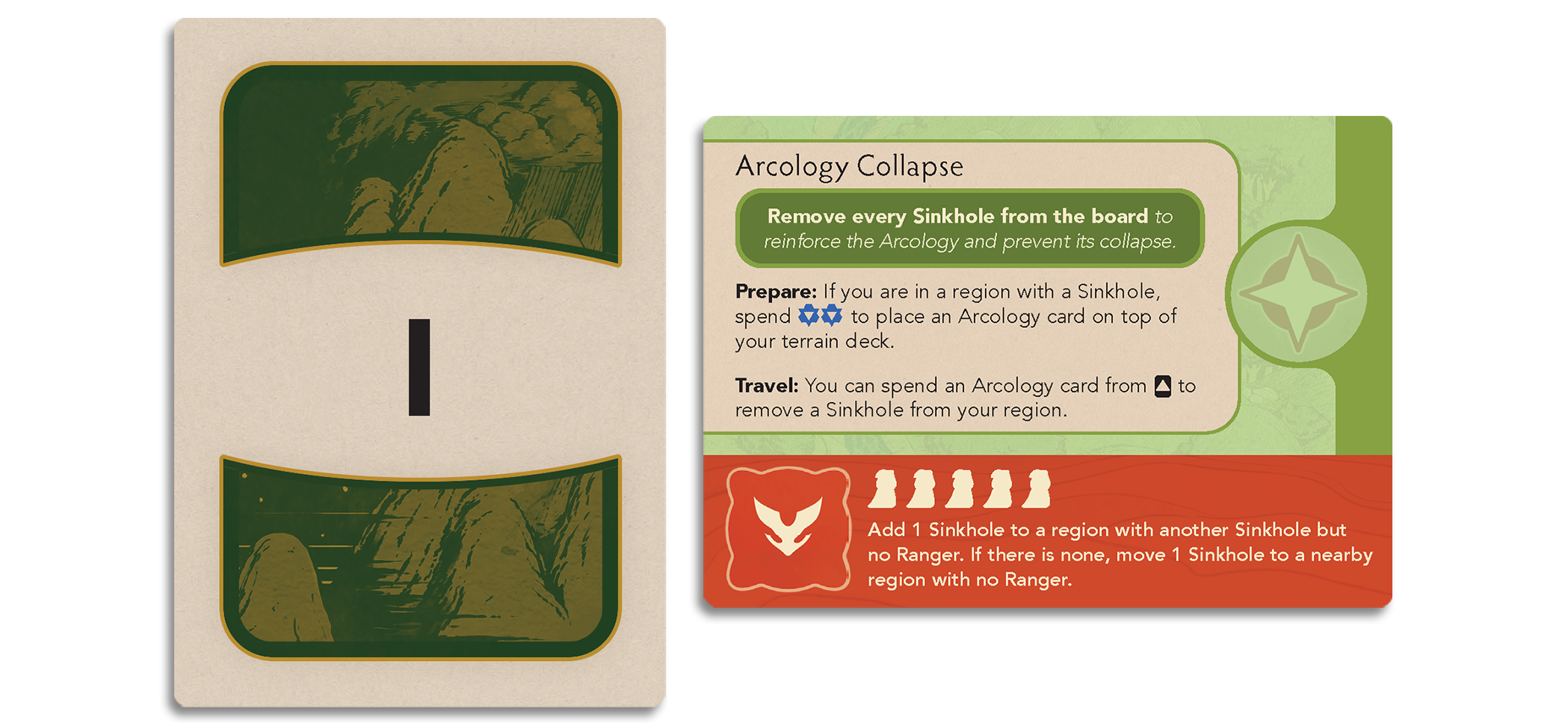
An endeavor and its associated deck.
Endeavors sit to the side of the board and add new rules and objectives to the game. They range from low-pressure shared objectives to tense, threatening crises that change the dynamic of the entire game. For example, the “Arcology Collapse” endeavor adds the threat of an impending collapse, but also adds an entirely new terrain deck Rangers can explore by venturing underground into the massive underground structure that tunnels beneath the Valley.
In some other similar games, a lot of the endeavors you uncover in this way would be presented as scenarios; a set of rules that alters how the game is played for that session. But it’s important to us that these emerge naturally through play. Additionally, since endeavors introduce smaller modular pieces, you can have game sessions where they overlap and interact in new and unpredictable ways (and since they emerge during play, it makes setup a breeze).
As you complete endeavors, you will also alter the world around you. For example, completing one might allow you to create a new spiderline network that makes traveling to the far reaches of the board a breeze for the rest of the game, or another might permanently change how the ecology of predator, prey, and flora meeples behaves for better, or for worse.
Authored and Emergent Interactions
The interaction of the new endeavors, events, encounters, companions, and gear added by the different storylines is where the dynamics of Earthborne Trailblazer really transform the experience and add a ton of variety. The interactions of these stories come in two forms: authored interactions and emergent ones.
The authored interactions are mostly tracked though the game elements in play as well as with notable events. When a card causes something about the world to change, it will instruct you to tuck it either under the game board or your player sheet, leaving a single line of text visible. During play, other game components can check against these notable events and react differently based on your previous actions. The events of one story might alter the course of another, or it might cause new opportunities to reveal themselves somewhere else in the world.
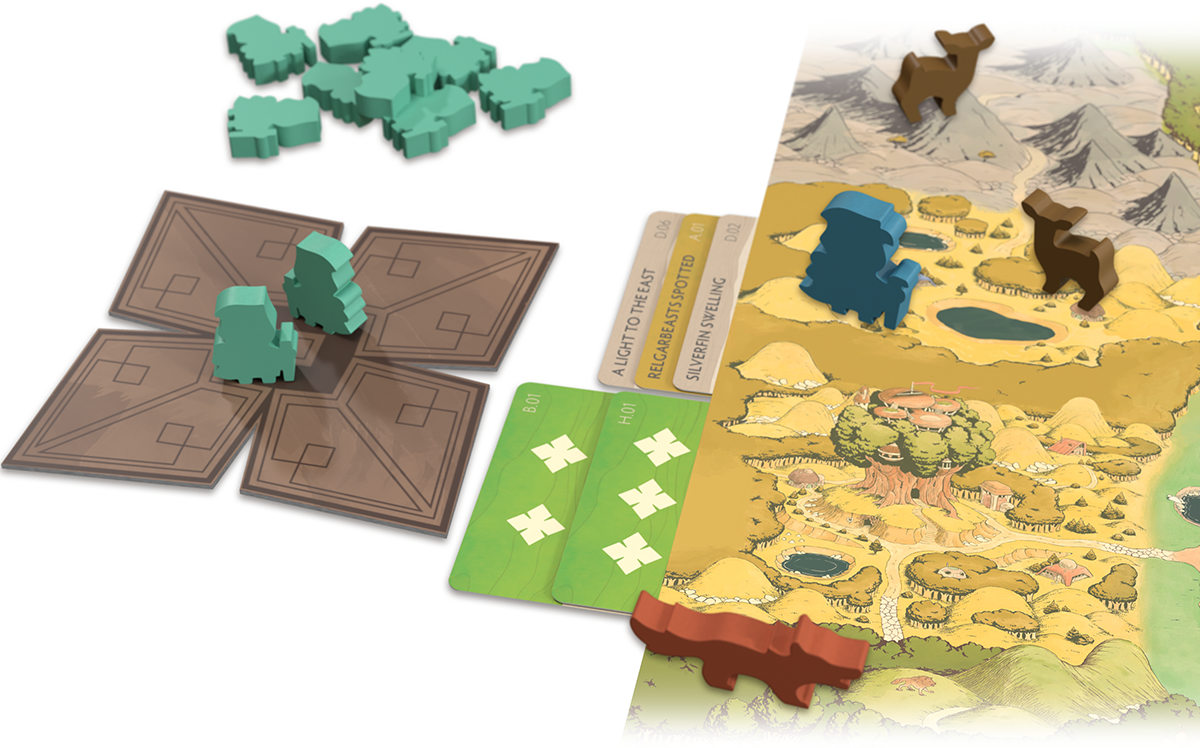
Notable event cards next to several scored ranger badges.
Emergent interactions, on the other hand, come out of how the endeavors and other parts of the story interact with the common game components such as the ecology on the board. By using this shared language to represent changes to the world, these different effects can converge to cause very different outcomes game to game.
For example, Aell, Humble Shaper will cause more flora to grow as you travel from region to region, adding flora meeples to the board , with the objective of propagating them across every region of the board. In one game, you might have Aell by your side while a “Wildfire!” endeavor is burning up all of the flora on the board, making his objective incredibly difficult, but also giving you a tool to control the Wildfires by manipulating the amount of flora on the board. In another game, biomodification to the flora could lead to rampant growth that is only exacerbated by Aell's presence, making it impossible to get around the board (unless you built those spiderlines I mentioned earlier!) In yet another game, working with the sentient plant beings known as the Verdessians might make distributing the flora a cinch … or a liability depending on their plans for it. Meanwhile, in all of these examples, extra flora means that more prey will be attracted to it, potentially throwing off the ecology and triggering other events and endeavors as a result.
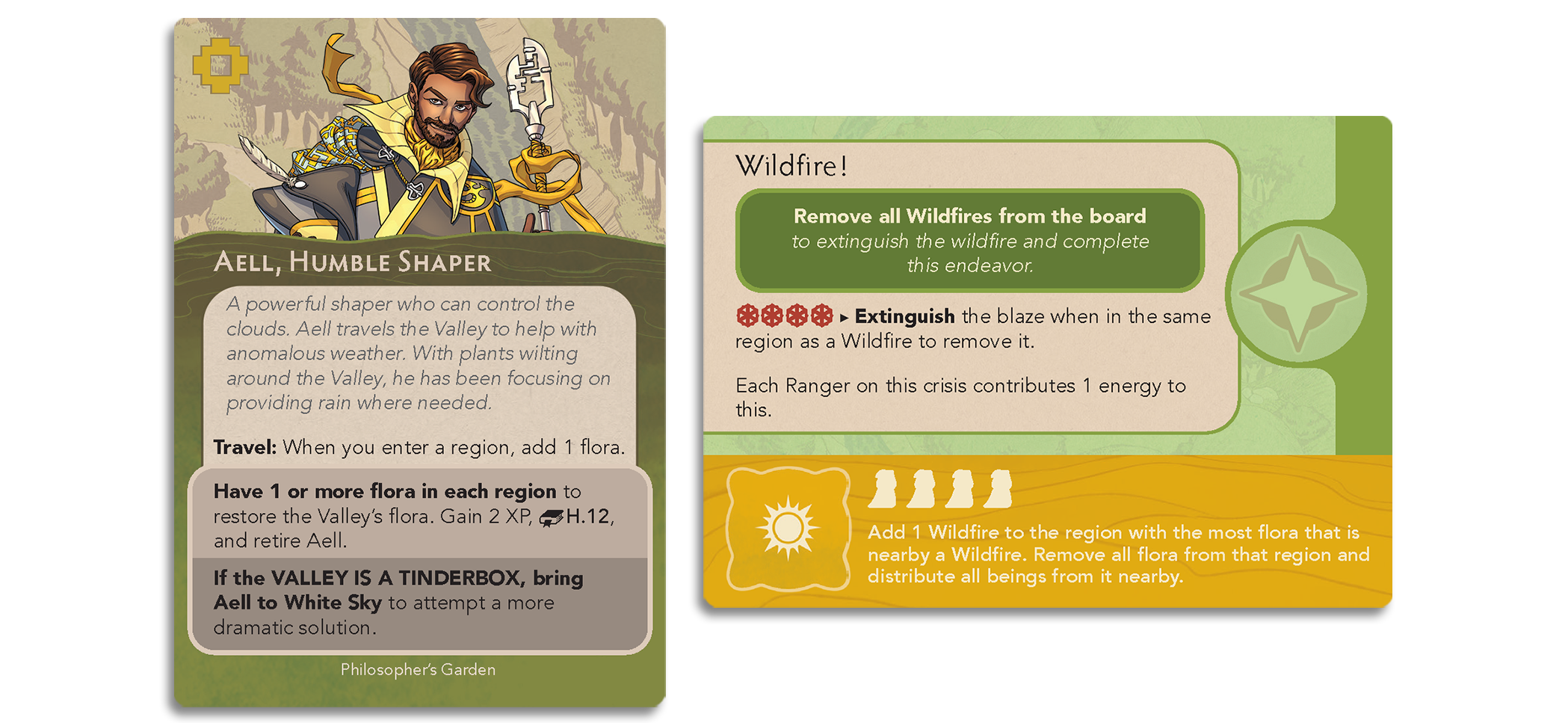
Aell, Humble Shaper and an endeavor he might interact with.
These quick examples are just from a single piece of the puzzle, and there are many, many more hidden around the open world. As is the case with Earthborne Rangers, it’s difficult to really comprehend the depth and variety that the game offers without having played it for yourself, and I’m really looking forward to hearing your stories once you do!
I hope this update gave you a deeper understanding of how a game of Earthborne Trailblazer will unfold, but there’s plenty more to learn! Let me know your questions about the design down in the comments, and we’ll do our best to answer them in a future update.
Subscribe to My Newsletter
The best way to stay up-to-date on my game design releases, articles, interviews, and appearances is to subscribe to my monthly newsletter below. Once a month. Comprehensive. Straight to the point. No spam.